

Family










A Special Way of Life Worth Exploring
How defying gender roles in farming led to fulfillment.

Caroline Gutman
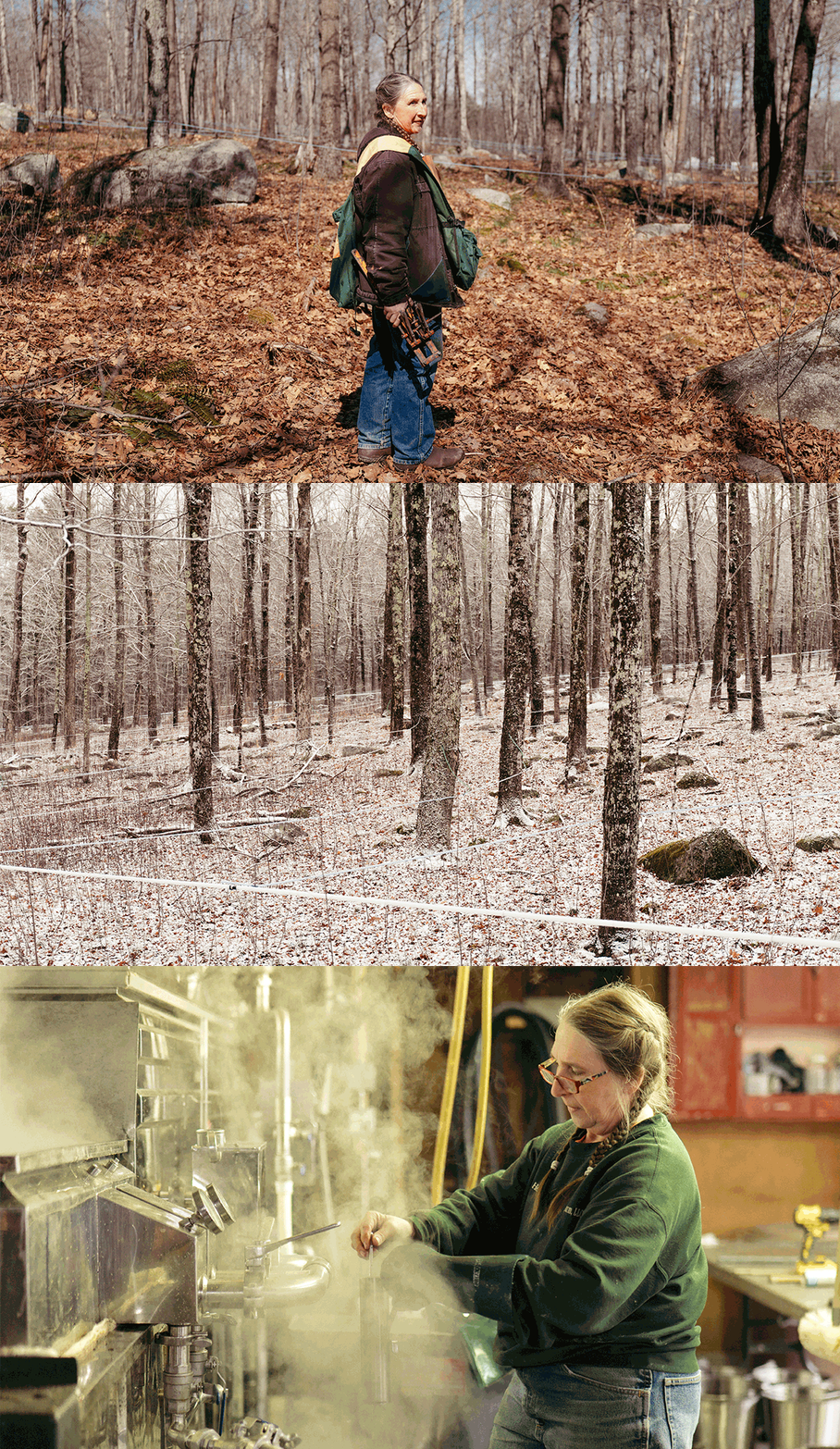
Heidi Bundy is looking forward to her vegetable garden. She’s trying to grow some flowers, too. The catch: she’s also managing a 257-year-old maple farm inherited from her great-great-great-great-grandfather.

Heidi Bundy poses for a portrait in the doorway of the sugar shack at Tomapo Farm, in Lebanon, New Hampshire, on March 24, 2026.
Caroline Gutman
Growing up, Heidi loved to be outdoors. Working on her family’s farm was enjoyable, and implied. She remembers her father working, harvesting maple from dawn till dusk, raising sheep with the 4-H club and being driven to fairs by her mother. Walks through the sugar woods and picnics with her grandmother on the property were common and joyful.

A sign outside Tomapo Farm reads National Bicentennial Farm, in Lebanon, New Hampshire, on March 24, 2026.
Caroline Gutman
After attending college for an associate’s degree in forestry, Heidi worked a smattering of farm jobs across New Hampshire while her father continued to run Tomapo Farm. She met her husband and they began raising their newborn daughter together — until her father called in 1990: Tomapo needed a bookkeeper.
Without hesitation, Heidi said yes, and soon moved back home to work for the family farm with her husband and daughter in tow. As she settled into her new role, managing invoices, orders, and inventory, other duties began to surface rather naturally.

Bottles containing maple syrup inside the syrup shack at Tomapo Farm, in Lebanon, New Hampshire, on March 23, 2026.
Caroline Gutman
After bookkeeping was settled, Heidi began working in the sugar wood, learning to tap, boil, and log the trees to harvest maple. She’d run the tractor back and forth while her father manned the cutting. They soon settled into a rhythm together. “He and I had an ability to communicate without words … a lift of an eyebrow … [a] wave of a finger." In the sugar house boiling sweet, gelatinous sap, there was no hearing one another over heavy machinery. Their collaboration transcended speaking into something of instinct.
The transition to management was gradual. As Heidi accumulated the skills and knowledge to run Tomapo, uncertainty still clouded her future: the responsibility was daunting.
With siblings elsewhere in New Hampshire running their own separate businesses, and a husband with little interest in a farming job, all the work in the woods, equipment repairs, heavy lifting seemed insurmountable for one woman to take on. Seeking education and community, Heidi took a women’s farming course through the Extension Foundation where she learned a valuable lesson: you don’t have to know it all to do it well.

Heidi Bundy uses a multi-tool to repair a maple tap line, at Tomapo Farm, in Lebanon, New Hampshire, on March 24, 2026.
Caroline Gutman

Get the Must-Read Newsletter for Older Women
Sign up for the free, weekly newsletter with the latest stories, expert advice, community updates, and more.
“I don't have to have the muscle to do whatever the heavy lifting is. I just have to know what my resources are. And at that point I said, okay, I know how to run the business.” The relief was palpable. Insight from the program about outsourcing specialized skills allowed Heidi to focus on what she did know, and enjoyed doing. “I know enough about the sugaring and the other items. I can do this as long as I can find the welder that I need to repair the tractor bucket” or whatever else arose. Heidi could assemble a team.
Despite the adjustment period, Heidi melted into the work, accepting that her confidence would ebb and flow. After all, her participation was a bit of a surprise, albeit a welcome one. It was an unsaid rule that “the male inherited the farm," so she and her family expected her brother would one day take it on.

Heidi Bundy's braided hair, at Tomapo Farm, in Lebanon, New Hampshire, on March 24, 2026.
Caroline Gutman
In fact, Tomapo’s ownership lineage was entirely men — until Heidi made a discovery. In the 1800s, her ancestor, Abel Towsend, had only daughters. At the time tuberculosis was devastating communities across the United States. Nellie, the daughter who most enjoyed working outdoors, survived the disease for that very reason, and eventually took on the farm when her father began to lose his vision. “I suspect that she and I had a lot in common," Heidi mused.
Like Nellie, “being in the woods is … my favorite part of this whole job," Heidi said through a smile. Being outside, and working with loved ones, was the sweetest part. “When people have come to me and said, ‘oh, we remember gathering sap with your father and grandfather, and it was so much fun.’ And I say, ‘yeah, you were soaking wet climbing uphill on snowshoes with two full 5 gallon pails of sap’." She laughed as she remembered all the fun she had with various people.
For Heidi, her work on Tomapo is far more than a job: “It’s a way of life.”

Framed family and farm photographs, wallpaper, and a price sheet, on the wall inside the Bundys' home at Tomapo Farm, in Lebanon, New Hampshire, on March 24, 2026.
Caroline Gutman
More From The Ethel


More for you, from AARP
We are a community from AARP. Discover more ways AARP can help you live well, navigate life, save money — and protect older Americans on issues that matter.